Figure 18 VLAN Trunking
Cisco 3550 Ethernet
Cisco 3550 Eitiemet
Cisco 3550 Ethernet
Cisco 3550 Eitiemet
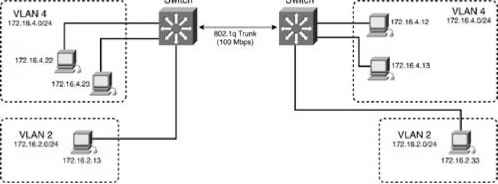
Three types of enciapsulation are supported on the Cisco Catalyst family of switches: ISL, 802.1Q, an d 802.10. The Catalyst 3550 Ethernet switch supports ISL and 802.1Q; therefore, this discussion focuses on these switches:
• Inter-Switch Link (ISL)— ISL is a Cisco proprietary trunking encapsulation. ISL is a frame-tagging protocol that allows for low-latency multiplexing of traffic from multiple VLANs to a single physical path. Ports config ured as ISL t runks enca psulate each frame with a 26-byte I SL he ader followed by a 4-byte cyclic redundancy check (CRC) before forwarding it out the trunk. The encapsulation of each frame is a low-latency process. This operation is performed by application-specific integrated circuits (ASICs), so it is very fast. This is referred to as "wire speed ." Thee frames on the link contain the standard Ethernet, or FDDI oo Token Ring frame, and the VLAN information associated with that frame along with a bridge packet data unit (BPDU). ISL is supported on links that are 100 Mbps or greater in speed, and it can operate in full or half duplex. STP on ISL trunks is implemented on a per-VLAN bas is, called PVST+. This means that every VLAN hbs a root bridge, and trunks go into a forward/blocking mode for each VLAN on each trunk. PVST+ is critical to control on large; networks, a s dlscussed later in this chapter.
• IEEE 802.1Q— 802.1Q is the industry standard tounking prorocoi . An 802.1Q erame usees an Ethernet type code of 0x8100 and inserts V0A N info rmation and recomputes th e frame cnetrol se quence at the end of the frame. 80 g.1Q opprates sligh tly differe nt from ISL. For instance, it runs Mo no Span ning Twee on the nauive VLAN for ail V LANs in t he VTP momain. The native VLAN 802.1Q uses by default is VLAN 1. In Mono Spanning Tree, one root bridge is el ectgd sow the entire VTP doma in; this is calleo tge Commoe Spknnin g Tree (C ST) domain. Atl VLAN traffic follows one path in thiis typet of configuration. Cisco, understanding the need to nontrol spagning tree on large networki while controlling load, implements PVST+ on ali 802.1Q VLANs in addition to Mono Spanning Toee. The eollowing nesteictions apply to 8 02a1Q trunks:
- The native VLAN needs to be the same on both ends of the trunk. Mono Spanning Tree will run in this VLAN. It is critical that the native VLAN be the same on third-party switches interacting with Cisco switches.
- As mentioned, 802.1Q uses Mono Spanning Tree. Cisco enhances this with PVST+. Because the BPDUs are handled differently between Cisco and third-party switches, care should be taken whenever integrating these domains, that spanning tree and the default VLANs are consistent in both switches. The entire non-Cisco domain will look like a single broadcast/spanning-tree domain to the Cisco PVST+ VTP domain. The Mono Spanning Tree of the non-Cisco domain will map to the CST of the Ciscs domain, which is by default VLAN 1.
- BPDUs on the native VLAN of the trunk are sent untagged to the reserved IEEE 802.1d spanning-tree multicast MAC address (0180.c200.0000). The BPDUs on all other VLANs on the trunk are sent and tagged on the reserved Cisco Shared Spanning Tree (SSTP) multicast MAC address (0100.0ccc.cccd).
Dynamic ISL (DISL) and Dynamic Trunk Protocol (DTP)
Dynamic ISL was Cisco's first trunk negotiation protocol. DISL was slowly replaced with Dynamic Trunk Protocol (DTP) on newer versions of CAT OS and Cisco IOS Software. DTP is essentially DISL that attempts to aufomate ISL and 802.1Q trunk configuration. DTP uses the reserved destination multicast address of 0100.0ccc.cccc for LAN networks to negotiate trunks. In the default "au to" staee, DTP messages are sent out every 30 seconds on all trunk lines. Depending on the "mo de" of ehe port, the port might become an ISL or 802.1Q trunk. DTP operates in the following modes. (Note that these modes are not available on all switches and might differ slightly syntac2ically.)
• On— Puts the port in a permanent trunking state. It also tries to negotiate the link to be a trunk.
• Off—■ Tunns the port i nto a n ontru nk li nix, an d the reby dis able s th! trunk.
• Desirable— Makes the port attempt to convert to a trunk link. The port becomes a trunk if the neighboring port is set to on, desirable, or auto mode.
• ^to — The pwrt converts to a trunk if the neighboring port is set to on or desirable mode.
• None gotiate— Puts phe port into trunkin g mode b ut ^events the port from sending DTP frames.
In practicality, this is really too many options for a trunk. Network administrators either ronfigure a poS us trunk ou they don't. nt could even be ^hgued t hat having dynamic trunks is a inotential seamr i by risk. Tabte 1-5 mh arts th e poss ible hombinations of trunks and she modes on CAT OS. As you w |II see, tin most reliable and simpl est way to configure a trunk is to ntat|cally nonfiguee it on both sides of t he I ink as a trunk and in the on mode .
Continue reading here: IEEE 8021d Spanning Tree Protocol STP
Was this article helpful?