Current State Authentication with 8021X
This section describes how 802.1AE and 802.1af extend the existing IEEE 802.1X protocol to provide continuous data protection in addition to authentication. To fully understand and appreciate the LinkSec security architecture, you must understand what LinkSec is and its key components; you must also identify the current state of network security at the link layer and how LinkSec extends it to build a robust security mechanism for the entire enterprise network.
As Chapter 17, "Identity-Based Networking Services with 802.1X," describes, 802.1X is an IEEE standard that is available in many industry products today.6 Networking devices, such as Layer 2 and Layer 3 Ethernet access switches, wireless LANs (WLAN), APs, WLAN controllers, and Layer 2 Ethernet ports in routers, can use 802.1X/EAP to authenticate entities joining a network.
NOTE For more information on identity-based network services with IEEE 802.1X, see Chapter 17.
The following is a cursory overview of the 802.1X Layer 2 wired authentication model and its current limitations with respect to what happens after successful authentication/ authorization.
The basic premise of this overview is that host devices attempting access are challenged for valid credentials before they are allowed network connectivity. After it's authenticated and authorized, the Layer 2 switch inspects incoming traffic from the user on the authenticated/ authorized port and filters frames, allowing only those with the authenticated MAC address. Although 802.1X is a highly recommended and essential component for 802.1AE, it alone cannot address unauthorized access to or prevent the tampering of information traversing our networks.
Note the following analogy: A security guard at a building entrance stops and validates personnel to ensure that authorized users enter the building. This does not prevent personnel from misbehaving after they gain entry. This is true for 802.1X in the case of network access. After a user authenticates and is granted access, he can still misbehave.
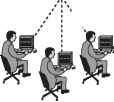
Let's look at the case of what has been termed shadow hosts (or piggy backing). This is achieved when a shared media device (such as a hub) is placed inline between a valid supplicant (a user) and the 802.1X authenticator (Ethernet port), as Figure 18-2 shows.
Figure 18-2 Shadow Hosts
Valid User Who Successfully Authenticates
EAP Request
EAP Response (with Valid Credentials)
Supplicant
Wall Jack in
Conference Room Authenticator
Non-Authenticated
Wall Jack in
EAP Response (with Valid Credentials)
|
f |
|
|
Wifing Closet Switch |
|
Relay Credentials to AAA via RADIUS
Relay Credentials to AAA via RADIUS
RADIUS-Accept
RADIUS-Accept
Conference Room Authenticator
Authentication Server
Non-Authenticated
©Shadow Users Unauthenticated & Unauthorized Users
In this scenario, the shadow users need to snoop the wire to obtain the valid user's MAC address and then spoof its traffic to contain that MAC address. Their packets are permitted on the 802.1X authenticated port. An 802.1AE-enabled Layer 2 Ethernet switch port and host network interface card (NIC) prevents this behavior. In the 802.1AE scenario, only packets with the valid MAC address and security association (SA) are allowed. Because the packets are encrypted, the would-be shadow users cannot snoop the wire to obtain the MAC address or SA of valid users. As such, miscreant users connected to the hub cannot gain network access, as Figure 18-3 shows. Additionally, because all traffic between the valid users are encrypted and checked for integrity, all communications are assured to be 100 percent confidential and authentic.
Figure 18-3 Shadow Hosts Blocked by 802.1AE
Figure 18-3 Shadow Hosts Blocked by 802.1AE

802.1X introduces a certain level of accountability through the logging provided by the authentication, authorization, and accounting (AAA) server and syslogs on the 802.1X access switch. The access switch provides useful information (such as authenticator access device, username, switch port, MAC address, IP address, VLAN assignment, time, date, and so on). Although this is useful to provide a certain level of accountability, it cannot be used with 100 percent certainty. To guarantee traceback, you must have the ability to prove that a miscreant user hasn't spoofed a MAC or IP address. 802.1AE provides the certainty required for 100 percent traceback to the host device whether it is for accounting or forensics.
To recap: For wired networks, after the client machine authenticates, no further measures are needed to secure the data traffic. In other words, the 802.1X model provides for onetime (or periodic) authentication of the entity, but it does nothing to protect the traffic. This leaves the door open for data traffic to be snooped, spoofed, or tampered with. The switch won't be able to distinguish rogue traffic from valid traffic because both flows have the same source MAC address of the authenticated client machine.
Continue reading here: Combining IPsec with L2TPv3 for Secure Pseudowire
Was this article helpful?
Readers' Questions
-
idris welde10 months ago
- Reply