Area areaid stub
Syntax Description:
® area-id— OSPF area ID. This value can be entered as a decimal number in the range of 0 to 4,294,967,295 or in IP address form in the range 0.0.0.0 to 255.255.255.255.
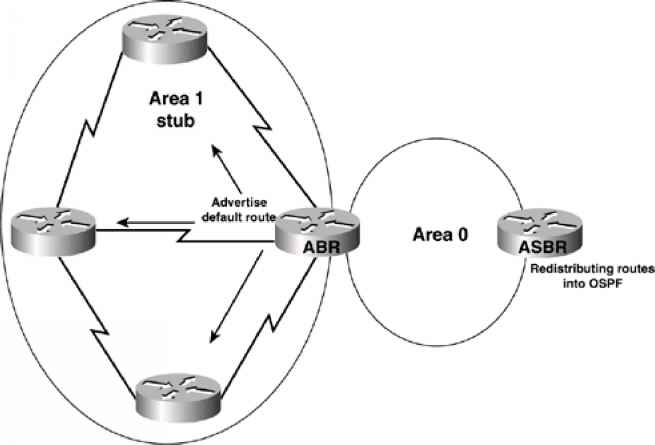
Purpose: In Figure 2-11. Area 1 has one exit point. Routers in Area 1 do not need to know the specific external routes that are being redistributed into OSPF by the ASBR. Therefore, Area 1 can be configured as a stub area and the ABR will advertise a default route into Area
Figure 2-11. An OSPF Stub Area with One Exit
Figure 2-11. An OSPF Stub Area with One Exit
In Figure 2-12, Area 1 has two exit points. If routing to the external networks that have been redistributed into OSPF by the ASBR can be sub-optimal, then Area 1 can be configured as a stub area. The routers in Area 1 will be receiving a default route advertisement from both ABRs. All routers in a stub area, including the ABR, must be configured with the command area area-id stub. Inter-area OSPF routes will be advertised into a stub area but external OSPF routes will be blocked. The ABR for the stub area will inject a default route into the stub area.
The backbone or Area 0 cannot be configured as a stub area. An ASBR cannot be part of a stub area since the purpose of an ASBR is to inject external routes into OSPF. A stub area cannot be used as the transit area for a virtual link.
Figure 2-12. An OSPF Stub Area with Multiple Exits
Figure 2-12. An OSPF Stub Area with Multiple Exits

Initial Cisco IOS Software Release: 10.0
Continue reading here: Figure 213 An OSPF Stub Area
Was this article helpful?