Configuring Selective VRF Import
mmmmmmmmmmmw mini mini mini mini iiiim mini 1111: 5¡¿0™
VRF import criteria might be more specific than just the match on the RT—for example:
• Import only routes with specific BGP attributes (community, and so on).
• Import routes with specific prefixes or subnet masks (only loopback addresses).
A route map can be configured in a VRF to make route import more specific.
«2003, Chco System*, Inc. All right* reserved. MPLS v2.0—«-5
Selective route import into a VRF allows you to narrow the route import criteria. It uses a route map that can filter the routes selected by the route target (RT) import filter. The routes imported into a VRF are Border Gateway Protocol (BGP) routes, so you can use match conditions in a route map to match any BGP attribute of a route. These attributes include communities, local preference, multi-exit discriminator (MED), autonomous system (AS) path, and so on.
The import route map filter is combined with the RT import filter. A route has to pass the RT import filter first and then the import route map. The necessary conditions for a route to be imported into a VRF are as follows:
■ At least one of the RTs attached to the route matches one of the import RTs configured in the VRF.
■ The route is permitted by the import route map.
Router(config-vrf)#
import map route-map
• This command attaches a route map to the VRF import process.
* A route is imported into the VRF only if at least one RT attached to the route matches one RT configured in the VRF and the route is accepted by the route map.
• 2KB, Cisco System*. Inc. All right* reserved. MPLS v2.0—-6
import map
To configure an import route map for a VRF, use the import map command in VRF configuration submode.
|
Parameter |
Description |
|
route-map |
Specifies the route map to be used as an import route map for the VRF. |
There is no default. A VRF has no import route map unless one is configured using the import map command.
Defaults
There is no default. A VRF has no import route map unless one is configured using the import map command.
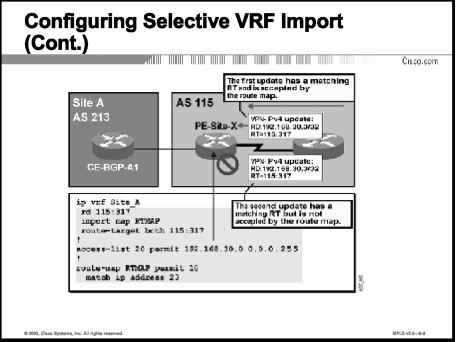
The figure shows an example in which an import route map is used to match the IP version 4 (IPv4) portion of incoming VPN IPv4 (VPNv4) routes and import into the VRF only routes matching a certain prefix. A configuration similar to this one could be used to accomplish the following:
■ Deploy advanced MPLS VPN topologies (for example, a managed router services topology that is detailed later in this module)
■ Increase the security of an extranet VPN by allowing only predefined subnets to be inserted into a VRF, thus preventing an extranet site from inserting unapproved subnets into the extranet
Note A similar function is usually not needed in an intranet scenario because ail customer routers in an intranet are usually under common administration.
Continue reading here: Steps to Configuring a Central Services VPN
Was this article helpful?