Advanced Registry Cleaner PC Diagnosis and Repair
Special Uninstaller

More Information
Special Uninstaller is an intelligent program installer created for computers that rely on a window-based operating system. It comes with an algorithm that allows it to detect any problem. It comes with a unique aspect that provides users with an effective uninstallation process that deeply scans after each removal so you can delete what's leftover, including registry traces, before reinstalling something else. The Special Uninstaller is a powerful and efficient uninstaller, which can help you remove stubborn built-in bloatware. It has tools like the autorun manager and windows tools to further enhance your experience with this software. They take on the mode of a hunter in ensuring all the unwanted information is gone from your system. The new and good-looking interface of the Special uninstaller is also very user-friendly, which might have been better because it doesn't look modern like IObit Uninstaller. But, It is enough and has a very good interface but not decent. When you open this program, you will get all the necessary options on the home page in the left sidebar. In fact, its UI is very simple, and no user can complain about its friendliness Read more...
Special Uninstaller Summary
Contents: Software
Official Website: www.specialuninstaller.com
Access Now
My Special Uninstaller Review

The interface is user friendly with its intuitive layout. Also, the addition of the prompt, with expert advice sets it apart from all the other similar programs. The Special Uninstaller installation process is clean and without any unpleasant surprises like hidden toolbars, adds or anything like that. However, the installation process takes a bit longer than expected and you actually have to go through ten steps before the installation is complete, but that can hardly be considered a downside though.
I personally recommend to buy this software. The quality is excellent and for this low price and 100% Money back guarantee, you have nothing to lose.

Uninstall Unity 3x and 4x

.Unity Uninstaller Uninstall The Unity Uninstaller utility will remove all Cisco Unity-related files, registry settings, and most directory items in Exchange and Active Directory from your system. You will need to manually remove three accounts (Example Administrator, Example Subscriber, Installer) and three distribution lists (System Event Messages, All Subscribers, and Unaddressed Messages) from your system after uninstalling. After that, you should be able to install a clean version of Cisco Unity, after rebooting your server. This version of Uninstaller works only with Cisco Unity 3.0(1) and later. There is a separate version for the 2.x uninstall. This tool does not remove Dialogic, network management system (NMS), Cisco Telephony Service Providers (TSPs), or WAV drivers. Before running the Cisco Unity Uninstall utility, you should manually remove these items. The Unity Uninstaller also does not remove Active Fax.
Allowing Scripted Uninterrupted Uninstall

When you attempt to run a silent command-line uninstallation, you often run into issues when the currently installed CSA policy queries prompt the user. These queries are typically related to stopping the agent service and running installation programs. You can circumvent these issues through CSA policy implementation and a tool like SysInternals PSEXEC, which allows you to run commands on local and remote systems as another user. To accomplish this, follow a few simple steps to make an additional policy that allows you to perform the unattended uninstallation without prompts. Step 1 Create two rule modules called Unattended CSA Uninstallation Rule Module and Unattended CSA Uninstallation Rule Module 2. For our example, use the Administrator state set for Unattended CSA Uninstallation Rule Module and System Account state set for Unattended CSA Uninstallation Rule Module 2. Figure 7-11 shows an example of setting the state set.
Quality Assurance Debugging

There are two ways to disable CSA temporarily that do not involve an uninstall reboot The following situation rarely occurs but you should understand it. You have an application that crashes, but it did not do this before installing CSA. However, after installing CSA (regardless of whether the agent funs or not), it crashes. This usually happens with Computer Aided Design (CAD) applications or other related applications that have extremely tight licensing code. This type of code watches for anything that looks like an operating system debugger and crashes if it thinks someone is trying to hack its licensing code. If you run into this situation and uninstalling CSA fixes the application, you can add One of these preceding methods usually assists the quality assurance staff in locating and narrowing down a problem without having to uninstall and reinstall the CSA for every issue that arises.

Setting Up Basic Host Scan

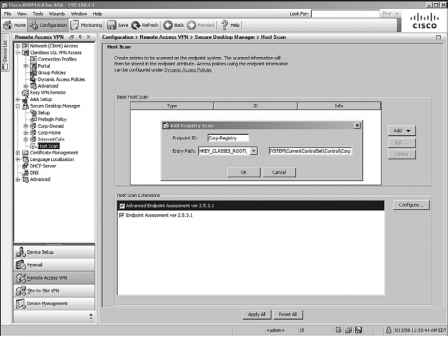
To configure CSD to scan a remote computer for basic information, click Add under Basic Host Scan and select the type of basic scan you would like to configure. As mentioned in the previous section, a basic Host Scan can identify registry keys, active processes, and files located on the remote workstation. For example, if you want CSD to scan a registry key from the workstation and based on that information you want to apply appropriate action by DAP, add Registry Scan under Basic Host Scan. The system prompts you to configure the following attributes Entry Path menu Select the initial path of the registry key from the drop-down menu. For example, if the registry key you want to scan resides at select HKEY_LOCAL_MACHINE from the drop-down menu. Entry Path field Specify the complete name of the registry key except the initial directory path that you provided on the Entry Path menu.
Cisco NAC Appliance Agent Cisco NAA The Cisco NAA software resides on
Microsoft Windows systems and can verify if an application or service is running and if a registry key exists or if the value of a registry key is known. The Cisco NAA is referred to as a read-only agent the Cisco NAA does not alter client system information, but reads the information and reports this information to the Cisco NAC Appliance Manager (Cisco NAM). The Cisco NAA ensures that, for example, a corporate laptop has an up-to-date configuration of the standard corporate software before the laptop is allowed to access the corporate network. The Cisco NAA can ensure that users install the resources necessary to keep their machines from becoming vulnerable or infected.
Cisco NAC Appliance Network Scanner

Network Scanner allows you to scan hosts to check for known vulnerabilities. Network Scanner is integrated into the NAC Appliance Manager and NAC Appliance Server software and is not a standalone piece. Network Scanner uses Nessus to scan hosts. You add in the Nessus plug-ins of your choice. For example, you can add the plug-ins that check to see whether music file-sharing applications are running on the host. If such programs are running, you could notify the end users that they must disable or uninstall the offending software before they are allowed on the network. Network Scanner can also be used to posture assess hosts that run operating systems not supported by Clean Access Agent, such as Linux.
Installing the Cisco VPN Client Through Install Shield
Step 6 If the InstallShield Wizard identifies an existing version of either the Cisco VPN 3000 Client or the Cisco VPN 5000 Client, it displays a dialog box that asks if you want to uninstall the existing client program. To continue, click Yes. The Cisco VPN Client launches the appropriate uninstall wizard the Cisco VPN Client uninstall wizard to uninstall a previous version of the Cisco VPN 3000 Client or the Cisco VPN 5000 Client. Follow the instructions on the uninstall wizard dialog boxes to automatically uninstall the program and reboot.
Any Connect VPN Client Configuration Guide
During the early development period of SSL VPNs, network administrators needed a VPN client that had similar benefits of an IPsec remote access VPN client, but required less administrative overhead than installing and maintaining the IPsec VPN client. To accommodate those requirements, the idea of a full tunnel SSL VPN client emerged. In the pre-version 8.0 releases, Cisco provided the SSL VPN Client (SVC). This is a self-downloading, self-installing, self-configuring, and self-uninstalling VPN that offers all benefits that are currently available in the Cisco IPsec client. However, in version 8.0 or later versions of Cisco ASA, Cisco introduced a newer SSL VPN client called Cisco AnyConnect VPN Client. The AnyConnect VPN clients leverage the SSL encryption engine that is already present on the client computer. If you currently use the pre-version 8.
Installing ACS on a Windows Server
Step 10 Enter a password that will be used to encrypt the local ACS database. The password must be at least eight characters in length and should include both letters and numbers. The password you enter is kept encrypted in the Windows Registry. Record the password you used and keep in a secure place. If there is ever a critical problem with the database, the password might be needed to access the database manually. After you enter the password, click Next to continue.
Cisco Clean Access Agent

Clean Access Agent is a free software program that resides on client PCs. It is a read-only agent whose job is to gather information about the user and the host it is installed on. It then matches that against the requirements received for that user, role, or OS from NAC Appliance Server and sends back a report to NAC Appliance Manager via NAC Appliance Server. If the requirements are met, the host is allowed on the network. If the host fails, Clean Access Agent presents the user, via a dialog box, with the remediation instructions received from NAC Appliance Manager. The information it checks for is configured by you at the NAC Appliance Manager level and then pushed out to each NAC Appliance Server. The information that can be checked by Clean Access Agent includes applications, files, registry keys, and services. For example, Clean Access Agent could check for the presence of a Windows hotfix or check to see whether an antivirus program is current.
Set Restore Points

Restore points return the operating system to a predefined point in time. In some cases, the installation of an application or a hardware driver can cause instability or create unexpected changes to the computer. Uninstalling the application or hardware driver normally corrects the problem. If uninstalling does not solve the problem, you should try to restore the computer to an earlier time when the system worked properly.
Step 1 Set Up CSD
2 Choose Configuration Remote Access VPN Secure Desktop Manager Windows Location Setting and define a prelogin sequence based on registry key and IP address range. Create a new Windows location called CorpOwnedHomeMachines that has a registry key check of and an address check where the address should not fall in the 209.165.200.224 27 subnet.
Configuring DAP
A user connection might match multiple DAP records. For example, you can have a DAP record that only scans the remote workstations for a registry key. You can have another DAP record that checks the remote computer for an active process. If a remote workstation has the registry key and the process is active as well, that workstation will match against both DAP records. In this case, the security appliance combines both records dynamically and applies an aggregated access policy to a user connection.
Patch Link
Figure 12-3 illustrates how the PatchLink Agent and Posture Plug-in communicate with CTA and the Windows Registry. Figure 12-3 illustrates how the PatchLink Agent and Posture Plug-in communicate with CTA and the Windows Registry. The PatchLink Agent communicates with CTA via the Posture Plug-in. It also reads and updates Windows Registry entries.
More Products
| PC Repair Tools | |
| Easy Tweaker Registry Cleaner & System Optimizer | |
| Regtweaker Registry Cleaner & Windows Optimizer | |
| Registry Easy Cleaner | |
| RegistryMum Registry Cleaner | |
| Regserve Registry Cleaner | |
| WiseFixer Registry Cleaner |