Planning the IP Addressing Hierarchy
The IP addressing hierarchy influences network routing. This section describes IP addressing hierarchy and how it reduces routing overhead. This section discusses the issues that influence the IP addressing plan and the routing protocol choice, including summarization, fixed-length subnet masking, variable-length subnet masking, and classful and classless routing protocols.
NOTE Chapter 7, "Selecting Routing Protocols for the Network," discusses routing protocols in detail.
Hierarchical Addressing
The telephone numbering system is a hierarchical system. For example, the North American Numbering Plan includes the country code, the area code, the local exchange, and the line number.
The telephone architecture has handled prefix routing, or routing based only on the prefix part of the address, for many years. For example, a telephone switch in Detroit, Michigan does not have to know how to reach a specific line in Portland, Oregon. It must simply recognize that the call is not local. A long-distance carrier must recognize that area code 503 is for Oregon, but it does not have to know the details of how to reach the specific line in Oregon.
The IP addressing scheme is also hierarchical, and prefix routing is not new in the IP environment either. As in the telephone example, IP routers make hierarchical decisions. Recall that an IP address comprises a prefix part and a host part. A router has to know only how to reach the next hop; it does not have to know the details of how to reach an end node that is not local. Routers use the prefix to determine the path for a destination address that is not local. The host part is used to reach local hosts.
Route Summarization
With route summarization, also referred to as route aggregation or supernetting, one route in the routing table represents many other routes. Summarizing routes reduces the routing update traffic (which can be important on low-speed links) and reduces the number of routes in the routing table and overall router overhead in the router receiving the routes. In a hierarchical network design, effective use of route summarization can limit the impact of topology changes to the routers in one section of the network.
If the Internet had not adapted route summarization by standardizing on classless interdomain routing (CIDR), it would not have survived.
CIDR
CIDR is a mechanism developed to help alleviate the problem of IP address exhaustion and growth of routing tables. The idea behind CIDR is that blocks of multiple addresses (for example, blocks of Class C address) can be combined, or aggregated, to create a larger (that is, more hosts allowed), classless set of IP addresses. Blocks of Class C network numbers are allocated to each network service provider; organizations using the network service provider for Internet connectivity are allocated subsets of the service provider's address space as required. These multiple Class C addresses can then be summarized in routing tables, resulting in fewer route advertisements. (Note that the CIDR mechanism can be applied to blocks of Class A, B, and C addresses; it is not restricted to Class C.) CIDR is described in RFC 1519, Classless Inter-Domain Routing (CIDR): An Address Assignment and Aggregation Strategy.
For summarization to work correctly, the following requirements must be met:
■ Multiple IP addresses must share the same leftmost bits.
■ Routers must base their routing decisions on a 32-bit IP address and a prefix length of up to 32 bits.
■ Routing protocols must carry the prefix length with the 32-bit IP address. For example, assume that a router has the following networks behind it:
192.168.168.0/24 192.168.169.0/24 192.168.170.0/24 192.168.171.0/24 192.168.172.0/24 192.168.173.0/24 192.168.174.0/24 192.168.175.0/24
Each of these networks could be advertised separately; however, this would mean advertising eight routes. Instead, this router can summarize the eight routes into one route and advertise 192.168.168.0/21. By advertising this one route, the router is saying, "Route packets to me if the destination has the first 21 bits the same as the first 21 bits of 192.168.168.0."
Figure 6-5 illustrates how this summary route is determined. The addresses all have the first 21 bits in common and include all the combinations of the other 3 bits in the network portion of the address; therefore, only the first 21 bits are needed to determine whether the router can route to one of these specific addresses.
Figure 6-5 Find the Common Bits to Summarize Routes
192.168 192.168 192.168 192.168 192.168 192.168 192.168 192.168
|
11000000 10101000 10101 |
000 |
00000000 |
|
11000000 10101000 10101 |
001 |
00000000 |
|
11000000 10101000 10101 |
010 |
00000000 |
|
11000000 10101000 10101 |
011 |
00000000 |
|
11000000 10101000 10101 |
100 |
00000000 |
|
11000000 10101000 10101 |
101 |
00000000 |
|
11000000 10101000 10101 |
110 |
00000000 |
|
11000000 10101000 10101 |
111 |
00000000 |
Number of Common Bits = 21
Number of Non-Common Network Bits = 3
Number of Host Bits = 8
Number of Common Bits = 21
Number of Non-Common Network Bits = 3
Number of Host Bits = 8
IP Addressing Hierarchy Criteria
IP addressing hierarchy has an important impact on the routing protocol choice, and vice versa. The decision about how to implement the IP addressing hierarchy is usually based on the following questions:
■ Is hierarchy needed within the IP addressing plan?
■ What are the criteria for dividing the network into route summarization groups?
■ How is route summarization performed, and what is the correlation with routing?
■ Is a hierarchy of route summarization groups required?
■ How many end systems does each route summarization group or subgroup contain?
Benefits of Hierarchical Addressing
A network designer decides how to implement the IP addressing hierarchy based on the network's size, geography, and topology. In large networks, hierarchy within the IP addressing plan is mandatory for a stable network (including stable routing tables). For the following reasons, a planned, hierarchical IP addressing structure, with room for growth, is recommended for networks of all sizes:
■ Influence of IP addressing on routing: An IP addressing plan influences the network's overall routing. Before allocating blocks of IP addresses to various parts of the network and assigning IP addresses to devices, consider the criteria for an appropriate and effective IP
addressing scheme. Routing stability, service availability, network scalability, and modularity are some crucial and preferred network characteristics and are directly affected by IP address allocation and deployment.
■ Modular design and scalable solutions: Whether building a new network or adding a new service on top of an existing infrastructure, a modular design helps to deliver a long-term, scalable solution. IP addressing modularity allows the aggregation of routing information on a hierarchical basis.
■ Route aggregation: Route aggregation is used to reduce routing overhead and improve routing stability and scalability. However, to implement route aggregation, a designer must be able to divide a network into contiguous IP address areas and must have a solid understanding of IP address assignment, route aggregation, and hierarchical routing.
Summarization Groups
To reduce the routing overhead in a large network, a multilevel hierarchy might be required. The depth of hierarchy depends on the network size and the size of the highest-level summarization group. Figure 6-6 shows an example of a network hierarchy.
Figure 6-6 IP Addressing Hierarchy

A typical organization has up to three levels of hierarchy:
■ First level: Network locations typically represent the first level of hierarchy in enterprise networks. Each location typically represents a group of summarized subnets, known as a summarization group.
■ Second level: A second level of hierarchy can be done within first-level summarization groups. For example, a large location can be divided into smaller summarization groups that represent the buildings or cities within that location. Not all first-level summarization groups require a second level of hierarchy.
■ Third level: To further minimize the potential routing overhead and instability, a third level of hierarchy can exist within the second-level summarization group. For example, sections or floors within individual buildings can represent the third-level summarization group.
Impact of Poorly Designed IP Addressing
A poorly designed IP addressing scheme usually results in IP addresses that are randomly assigned on an as-needed basis. In this case, the IP addresses are most likely dispersed through the network with no thought as to whether they can be grouped or summarized. A poor design provides no opportunity for dividing the network into contiguous address areas, and therefore no means of implementing route summarization.
Figure 6-7 is a sample network with poorly designed IP addressing; it uses a dynamic routing protocol. Suppose that a link in the network is flapping (changing its state from UP to DOWN, and vice versa) ten times per minute. Because dynamic routing is used, the routers that detect the change send routing updates to their neighbors, those neighbors send it to their neighbors, and so on. Because aggregation is not possible, the routing update is propagated throughout the entire network, even if there is no need for a distant router to have detailed knowledge of that link.
Figure 6-7 A Poorly Designed IP Addressing Scheme Results in Excess Routing Traffic
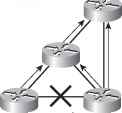
Impacts of poorly designed IP addressing include the following:
■ Excess routing traffic consumes bandwidth: When any route changes, routers send routing updates. Without summarization, more updates are sent, and the routing traffic consumes more bandwidth.
■ Increased routing table recalculation: Routing updates require routing table recalculation, which affects the router's performance and ability to forward traffic.
■ Possibility of routing loops: When too many routing changes prevent routers from converging with their neighbors, routing loops might occur, which might have global consequences for an organization.
Benefits of Route Aggregation
Implementing route aggregation on border routers between contiguously addressed areas controls routing table size. Figure 6-8 shows an example of implementing route summarization (aggregation) on the area borders in a sample network. If a link within an area fails, routing updates are not propagated to the rest of the network, because only the summarized route is sent to the rest of the network, and it has not changed; the route information about the failed link stays within the area. This reduces bandwidth consumption related to routing overhead and relieves routers from unnecessary routing table recalculation.
Figure 6-8 A Hierarchical IP Addressing Plan Results in Reduced Routing Traffic
Figure 6-8 A Hierarchical IP Addressing Plan Results in Reduced Routing Traffic

Efficient aggregation of routing advertisements narrows the scope of routing update propagation and significantly decreases the cumulative frequency of routing updates.
Fixed- and Variable-Length Subnet Masks
Another consideration when designing the IP addressing hierarchy is the subnet mask to use— either the same mask for the entire major network or different masks for different parts of the major network.
KEY A major network is a Class A, B, or C network. POINT
Fixed-Length Subnet Masking (FLSM) is when all subnet masks in a major network must be the same.
Variable-Length Subnet Masking (VLSM) is when subnet masks within a major network can be different. In modern networks, VLSM should be used to conserve the IP addresses.
Some routing protocols require FLSM; others allow VLSM.
FLSM requires that all subnets of a major network have the same subnet mask, which therefore results in less efficient address space allocation. For example, in the top network shown in Figure 6-9, network 172.16.0.0/16 is subnetted using FLSM. Each subnet is given a /24 mask. The network is composed of multiple LANs that are connected by point-to-point WAN links. Because FLSM is used, all subnets have the same subnet mask. This is inefficient, because even though only two addresses are needed on the point-to-point links, a /24 subnet mask with 254 available host addresses is used.
Figure 6-9 Fixed-Length Versus Variable-Length Subnet Mask
FLSM 172.16.0.0/24
VLSM 172.16.0.0/24
VLSM makes it possible to subnet with different subnet masks and therefore results in more efficient address space allocation. VLSM also provides a greater capability to perform route summarization, because it allows more hierarchical levels within an addressing plan. VLSM
requires prefix length information to be explicitly sent with each address advertised in a routing update.
For example, in the lower network shown in Figure 6-9, network 172.16.0.0/16 is subnetted using VLSM. The network is composed of multiple LANs that are connected by point-to-point WAN links. The point-to-point links have a subnet mask of /30, providing only two available host addresses, which is all that is needed on these links. The LANs have a subnet mask of /24 because they have more hosts that require addresses.
Routing Protocol Considerations
To use VLSM, the routing protocol in use must be classless. Classful routing protocols permit only FLSM.
KEY POINT
With classful routing, routing updates do not carry the subnet mask. With classless routing, routing updates do carry the subnet mask.
Classful Routing Protocols
As illustrated at the top of Figure 6-10, the following rules apply when classful routing protocols are used:
■ The routing updates do not include subnet masks.
■ When a routing update is received and the routing information is about one of the following:
— Routes within the same major network as configured on the receiving interface, the subnet mask configured on the receiving interface is assumed to apply to the received routes also. Therefore, the mask must be the same for all subnets of a major network. In other words, subnetting must be done with FLSM.
— Routes in a different major network than configured on the receiving interface, the default major network mask is assumed to apply to the received routes. Therefore, automatic route summarization is performed across major network (Class A, B, or C) boundaries, and subnetted networks must be contiguous.
Figure 6-10 Classful Versus Classless Routing Protocols
Classful
Automatic Route Summarization on Network Boundary
|
Routing Table |
||||||||||||||||||||||||||||||||||||||||||||||||||||||||||||||||
|
Destination |
Next Hop |
|||||||||||||||||||||||||||||||||||||||||||||||||||||||||||||||
|
172.16.0.0 |
No Automatic Route Summarization on Network Boundaries Necessary 192.168.2.0/24
Figure 6-11 illustrates a sample network with a discontiguous 172.16.0.0 network that runs a classful routing protocol. Routers A and C automatically summarize across the major network boundary, so both send routing information about 172.16.0.0 rather than the individual subnets (172.16.1.0/24 and 172.16.2.0/24). Consequently, Router B receives two entries for the major network 172.16.0.0, and it puts both entries into its routing table. Router B therefore might make incorrect routing decisions. Figure 6-11 Classful Routing Protocols Do Not Send the Subnet Mask in the Routing Update
Because of these constraints, classful routing is not often used in modern networks. Routing Information Protocol (RIP) version 1 (RIPvl) is an example of a classful routing protocol. Classless Routing Protocols As illustrated in the lower portion of Figure 6-10, the following rules apply when classless routing protocols are used: ■ The routing updates include subnet masks. ■ VLSM is supported. ■ Automatic route summarization at the major network boundary is not required, and route summarization can be manually configured. ■ Subnetted networks can be discontiguous. Consequently, all modern networks should use classless routing. Examples of classless routing protocols include RIP version 2 (RIPv2), Enhanced Interior Gateway Routing Protocol (EIGRP), OSPF, IS-IS, and Border Gateway Protocol (BGP). NOTE The classless routing protocols do not all behave the same regarding summarization. For example, RIPv2 and EIGRP automatically summarize at the network boundary by default, but they can be configured not to, and they can be configured to summarize at other address boundaries. Open Shortest Path First (OSPF) and Intermediate System-to-Intermediate System (IS-IS) do not summarize at the network boundary by default; they can be configured to summarize at other address boundaries. Figure 6-12 illustrates how discontiguous networks are handled by a classless routing protocol. This figure shows the same network as in Figure 6-11, but running a classless routing protocol that does not automatically summarize at the network boundary. In this example, Router B learns about both subnetworks 172.16.1.0/24 and 172.16.2.0/24, one from each interface; routing is performed correctly. NOTE Although using discontiguous subnets with classless routing protocols does not pose the routing issues demonstrated in Figure 6-11, contiguous blocks of IP networks should be used whenever possible to promote more efficient summarization. Figure 6-12 Classless Routing Protocols Send the Subnet Mask in the Routing Update 172.16.1.0/24 A 192.168.1.0/24 B ^ 192.168.2.0/24 C ^ 172.16.2.0/24
Hierarchical IP Addressing and Summarization Plan Example Recall that the number of available host addresses on a subnet is calculated by the formula 2h - 2, where h is the number of host bits (the number of bits set to 0 in the subnet mask). The first two columns in Table 6-3 show the location and number of IP addresses required at each location for the sample network shown in Figure 6-4. The third column in this table is the next highest power of 2 from the required number of addresses; this value is used to calculate the required number of host bits, as shown in the fourth column. Assuming that the Class B address 172.16.0.0/16 is used to address this network, the fifth column illustrates sample address blocks allocated to each location. Readers' Questions
1 Note that because the largest remote office needs 35 addresses and there is plenty of address space, 64 addresses are allocated to each remote office. 1 Note that because the largest remote office needs 35 addresses and there is plenty of address space, 64 addresses are allocated to each remote office. For the main campus, 2048 addresses are allocated; 11 host bits are required. This subnet is further divided into smaller subnets supporting floors or wiring closets. For the Denver region, 1024 addresses are allocated; 10 host bits are required. This address block is further divided into smaller subnets supporting buildings, floors, or wiring closets. Similarly, for the Houston region, 1024 addresses are also allocated and further subdivided, as shown in Table 6-3. Figure 6-13 illustrates one of the links in the Denver region going down and how summarization is performed to reduce routing update traffic. Figure 6-13 Hierarchical IP Addressing Plan Example Figure 6-13 Hierarchical IP Addressing Plan Example 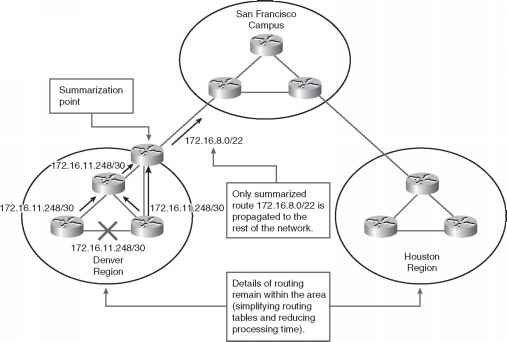
Continue reading here: Methods of Assigning IP Addresses Was this article helpful? |
|||||||||||||||||||||||||||||||||||||||||||||||||||||||||||||||