Identifying Customer Requirements
As the organization's network grows, so does the organization's dependency on the network and the applications that use it. Network-accessible organizational data and mission-critical applications that are essential to the organization's operations depend on network availability.
To design a network that meets customers' needs, the organizational goals, organizational constraints, technical goals, and technical constraints must be identified. This section describes the process of determining which applications and network services already exist and which ones are planned, along with associated organizational and technical goals and constraints. We begin by explaining how to assess the scope of the design project. After gathering all customer requirements, the designer must identify and obtain any missing information and reassess the scope of the design project to develop a comprehensive understanding of the customer's needs.
Assessing the Scope of a Network Design Project
When assessing the scope of a network design, consider the following:
- Whether the design is for a new network or is a modification of an existing network.
- Whether the design is for an entire enterprise network, a subset of the network, or a single segment or module. For example, the designer must ascertain whether the design is for a set of Campus LANs, a WAN, or a remote-access network.
- Whether the design addresses a single function or the network's entire functionality.
Examples of designs that would involve the entire network include one in which all branch office LANs are upgraded to support Fast Ethernet, and a migration from traditional Private Branch Exchange (PBX)-based telephony to an IP telephony solution. A project to reduce bottlenecks on a slow WAN is an example that would likely affect only the WAN. Adding wireless client mobility or provisioning core redundancy are designs that would likely affect only the campus.
The Open Systems Interconnection (OSI) reference model is important during the design phase. The network designer should review the project scope from the protocol layer perspective and decide whether the design is needed for only the network layer, or if other layers are also involved. For example:
- The network layer includes the routing and addressing design.
- The application layer includes the design of application data transport (such as transporting voice).
- The physical and data link layers include decisions about the connection types and the technologies to be used, such as Gigabit Ethernet, Asynchronous Transfer Mode, and Frame Relay.
NOTE Appendix C, "Open System Interconnection (OSI) Reference Model," details the seven layers of the OSI reference model.
Table 2-1 exhibits sample results of assessing the scope of design for a sample enterprise, Corporation X.
Table 2-1 Corporation X Network Design Scope Assessment
|
Scope of Design |
Comments |
|
Entire network |
The backbone at the central office needs to be redesigned. All branch offices' LANs will be upgraded to Fast Ethernet technology. |
|
Network layer |
Introduction of private IP addresses requires a new addressing plan. Certain LANs must also be segmented. Routing must be redesigned to support the new addressing plan and to provide greater reliability and redundancy. |
|
Data link layer |
The central office backbone and some branch offices require redundant equipment and redundant links are needed. The organization also requires a campus wireless radio frequency (RF) site survey to determine mobility deployment options and equipment scope. |
Identifying Required Information
Determining requirements includes extracting initial requirements from the customer and then refining these with other data that has been collected from the organization.
Extracting Initial Requirements
Initial design requirements are typically extracted from the Request for Proposal (RFP) or Request for Information (RFI) documents that the customer issues. An RFP is a formal request to vendors
for proposals that meet the requirements that the document identifies. An RFI is typically a less formal document an organization issues to solicit ideas and information from vendors about a specific project.
The first step in the design process should be predocumenting (sifting, processing, reordering, translating, and so forth) the design requirements and reviewing them with the customer for verification and approval, obtaining direct customer input, in either oral or written form. Figure 2-6 illustrates an iterative approach to developing the design requirements document.
Figure 2-6 Iterative Approach to Identifying Customer Requirements

Figure 2-6 illustrates the following steps:
Step 1 Extract the initial customer requirements (from the RFP or RFI).
Step 2 Query the customer for a verbal description of the initial requirements.
Step 3 Produce a draft document that describes the design requirements.
Step 4 Verify the design requirements with the customer, and obtain customer approval.
Step 5 Revise the document as necessary to eliminate errors and omissions.
Steps 2 to 5 are repeated if the customer has additional comments about the draft document.
Gathering Network Requirements
As illustrated in Figure 2-7, the process of gathering requirements can be broken down into five steps. During these steps (which are sometimes called milestones), the designer discusses the
project with the customer's staff to determine and gather the necessary data, including appropriate documentation.
Figure 2-7 Gathering Data for Design Requirements
Figure 2-7 Gathering Data for Design Requirements
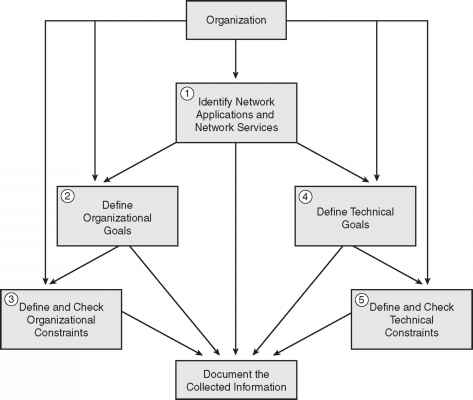
As shown in Figure 2-7, the steps are as follows:
As shown in Figure 2-7, the steps are as follows:
|
Step |
1 |
Identify the planned network applications and network services. |
|
Step |
2 |
Determine the organizational goals. |
|
Step |
3 |
Determine the possible organizational constraints. |
|
Step |
4 |
Determine the technical goals. |
|
Step |
5 |
Determine the technical constraints that must be taken into account. |
These steps provide the designer with data that must be carefully interpreted, analyzed, and presented to support the design proposal. Throughout these steps, the designer takes thorough notes, produces documentation, and presents the findings to the customer for further discussion.
The process is not unidirectional; the designer might return to a step and make additional inquiries about issues as they arise during the design process. The next five sections detail these steps.
Planned Applications and Network Services
The designer must determine which applications the customer is planning to use and the importance of each of these applications. Using a table helps organize and categorize the applications and services planned; the table should contain the following information:
%u25A0 Planned application types: Include e-mail, groupware (tools that aid group work), voice networking, web browsing, video on demand (VoD), databases, file sharing and transfer, computer-aided manufacturing, and so forth.
%u25A0 Applications: Specific applications that will be used, such as Microsoft Internet Explorer, Cisco Unified MeetingPlace, and so forth.
%u25A0 Level of importance: The importance of the applications—whether critical or important or not important—is noted.
%u25A0 Comments: Additional notes taken during the data-gathering process.
Table 2-2 shows an example of data gathered about the planned applications for the sample company, Corporation X.
Table 2-2 Corporation X's Planned Applications
Table 2-2 Corporation X's Planned Applications
|
Application Type |
Application |
Level of Importance (Critical, Important, Not Important) |
Comments |
|
|
Microsoft Office Outlook |
Important |
|
|
Groupware |
Cisco Unified MeetingPlace |
Important |
Need to be able to share presentations and applications during remote meetings |
|
Web browsing |
Microsoft Internet Explorer, Netscape Navigator, Opera |
Important |
|
|
Video on demand |
Cisco Digital Media System |
Critical |
|
|
Database |
Oracle |
Critical |
All data storage is based on Oracle |
|
Customer support applications |
Custom applications |
Critical |
NOTE The Cisco Digital Media System is an enhanced system that can be used in place of the Cisco Internet Protocol Television (IP/TV) products; Cisco has announced the end-of-sale and end-of-life dates for the Cisco IP/TV 3400 Series products. See http://www.cisco.com/en/ US/netsol/ns620/networking_solutions_white_paper0900aecd80537d33.shtml for more details.
NOTE Information on the Opera browser is available at http://www.opera.com/.
The planned infrastructure services table is similar to the planned application table. It lists infrastructure services that are planned for the network and additional comments about those services.
Recall that infrastructure services include security, QoS, network management, high availability, and IP multicast. Software distribution, backup, directory services, host naming, and user authentication and authorization are examples of other services and solutions that are deployed to support a typical organization's many applications. Table 2-3 shows sample data that was gathered about the infrastructure services planned for the sample company, Corporation X.
Table 2-3 Corporation X's Planned Infrastructure Services
Table 2-3 Corporation X's Planned Infrastructure Services
|
Service |
Comments |
|
Security |
Deploy security systematically: Firewall technology to protect the internal network; virus-scanning application to check incoming traffic for viruses; intrusion detection and prevention systems to protect from and inform about possible outside intrusions. Consider the use of authentication, authorization, and accounting systems to ensure that only authenticated and authorized users have access to specific services. |
|
QoS |
Implementation of QoS to prioritize more important and more delay-sensitive traffic over less important traffic (higher priority for voice and database traffic; lower priority for HTTP traffic). |
|
Network management |
Introduction and installation of centralized network management tools (such as HP OpenView with CiscoWorks applications) for easier and more efficient network management. |
|
High availability |
Use redundant paths and terminate connections on different network devices to eliminate single points of failure. |
|
IP multicast |
Introduction of IP multicast services needed for the introduction of videoconferencing and e-learning solutions. |
|
Voice |
Company wants to migrate to IP telephony. |
|
Mobility |
Need mobility for employees and guest access for clients. |
Organizational Goals
Every design project should begin by determining the organizational goals that are to be achieved. The criteria for success must be determined, and the consequences of a failure understood.
Network designers are often eager to start by analyzing the technical goals before considering the organizational goals and constraints. However, detailed attention to organizational goals and constraints is important for a project's success. In discussions about organizational goals, the designer obtains knowledge about the customer's expectations of the design's positive outcomes for the organization. Both short- and long-term goals should be identified. This organization-centered approach allows the network to become a strategic asset and competitive weapon for the customer.
Preliminary research on the organization's activities, products, processes, services, market, suppliers, competitive advantages, and structure enhances the positioning of the technologies and products to be used in the network.
This is an opportunity to determine what is important to the customer. Some sample questions a designer might ask to help determine organizational goals include the following:
%u25A0 What are you trying to accomplish with this project?
%u25A0 What business challenges are you currently facing?
%u25A0 What are the consequences of not resolving these issues?
%u25A0 How would you measure or quantify success if you could fix or correct the identified problems and issues?
%u25A0 What applications are most critical to your organization?
%u25A0 What is the major objective of this project?
%u25A0 What is driving the change?
%u25A0 Do you need to support any government or safety or legal mandates?
%u25A0 What are your main concerns with the implementation of a new solution?
%u25A0 What technologies or services are needed to support your objectives?
%u25A0 What other technology projects and business initiatives will affect your group in the next two to five years?
%u25A0 What skill sets does your technical staff currently have?
%u25A0 What is your goal for return on investment?
Organizational goals differ from organization to organization. The following are some typical
goals that commercial organizations might have:
%u25A0 Increase the operation's generated revenue and profitability. A new design should reduce costs in certain segments and propel growth in others. The network designer should discuss with the customer any expectations about how the new network will influence revenues and profits.
%u25A0 Shorten development cycles and enhance productivity by improving internal data availability and interdepartmental communications.
%u25A0 Improve customer support and offer additional customer services that can expedite reaction to customer needs and improve customer satisfaction.
%u25A0 Open the organization's information infrastructure to all key stakeholders (prospects, investors, customers, partners, suppliers, and employees), and build relationships and information accessibility to a new level.
NOTE Similar, though not identical, goals are common to governmental, charitable, religious, and educational organizations. Most of these entities focus on using available resources effectively to attain the organization's goals and objectives. In not-for-profit organizations, key measures are typically stated in terms of cost containment, service quality, service expansion, and resource deployment. This section emphasizes the deployment of networks in commercial organizations as an example of the type of research required for establishing the network requirements.
To illustrate the importance of considering organizational goals in a network design, consider two manufacturing enterprises that are contemplating network updates. Enterprise A's main reason for change is to improve customer satisfaction. It has received many complaints that customer information is difficult to obtain and understand, and there is a need for online ordering capability. In contrast, Enterprise B is driven by the need to reduce costs—this is a mandate from its CEO. When design decisions are made, these goals will most likely result in different outcomes. For example, Enterprise A might choose to implement an integrated product information database with e-commerce capability, whereas Enterprise B might not see the value of investing in this technology.
Following are examples of the types of data that can be gathered about some common
organizational goals:
%u25A0 Increase competitiveness: List competitive organizations and their advantages and weaknesses. Note possible improvements that might increase competitiveness or effectiveness.
%u25A0 Reduce costs: Reducing operational costs can result in increased profitability (even without a revenue increase) or increased services with the same revenue. List current expenses to help determine where costs could be reduced.
%u25A0 Improve customer support: Customer support services help provide a competitive advantage. List current customer support services, with comments about possible and desired improvements.
%u25A0 Add new customer services: List current customer services, and note future and desired (requested) services.
Table 2-4 presents data gathered about the organizational goals of a sample company, Corporation X.
Table 2-4 Corporation X's Organizational Goals
Table 2-4 Corporation X's Organizational Goals
|
Organizational Goal |
Gathered Data (Current Situation) |
Comments |
|
Increase competitiveness |
Corporation Y Corporation Z |
Better products Reduced costs |
|
Reduce cost |
Repeating tasks—entering data multiple times, time- consuming tasks |
Single data-entry point Easy-to-learn applications Simple data exchange |
|
Improve customer support |
Order tracking and technical support is done by individuals |
Introduction of web-based order tracking and web-based tools for customer technical support |
|
Add new customer services |
Current services: Telephone and fax orders, and telephone and fax confirmation |
Secure web-based ordering Secure web-based confirmations |
Organizational Constraints
When assessing organizational goals, it is important to analyze any organizational constraints that
might affect the network design. Some sample questions the designer might ask to help determine
organizational constraints include the following:
%u25A0 What in your current processes works well?
%u25A0 What in your current processes does not work well?
%u25A0 Which processes are labor-intensive?
%u25A0 What are the barriers for implementation in your organization?
%u25A0 What are your major concerns with the implementation of a new solution?
%u25A0 What financial and timing elements must be considered?
%u25A0 What projects already have budget approval?
%u25A0 Are other planned technology projects and business initiatives compatible with your current infrastructure and technology solutions?
%u25A0 What qualifications does your current staff have? Do you plan to hire more staff? If so, for what roles?
%u25A0 Do you have a budget for technical development for your staff?
%u25A0 Are there any policies in place that might affect the project?
Typical constraints include the following:
%u25A0 Budget: Reduced budgets or limited resources often force network designers to implement an affordable solution rather than the best technical solution. This usually entails some compromises in availability, manageability, performance, and scalability. The budget must include all equipment purchases, software licenses, maintenance agreements, staff training, and so forth. Budget is often the final decision point for design elements, selected equipment, and so on. The designer must know how much money is available to invest in a solid design. It also useful to know the areas in which the network can be compromised to meet budget requirements.
%u25A0 Personnel: The availability of trained personnel within the organization might be a design consideration. Organizations might not have enough trained personnel, or they might not have enough personnel. Familiarity with both the equipment and technologies speeds deployment and reduces cost, and trained technicians must be available to verify that all network elements are working. Therefore, the designer must know the number and availability of operations personnel, their expertise, and possible training requirements. Additional constraints might be
imposed if the organization is outsourcing network management. The designer must consider the network's implementation and maintenance phases, which require adequately trained staff.
%u25A0 Policies: Organizations have different policies about protocols, standards, vendors, and applications; to design the network successfully, the designer must understand these policies. For example, the designer should determine customer policies related to single-vendor or multivendor platforms; an end-to-end single-vendor solution might be a benefit, because compatibility issues do not restrain the network. As another example, many organizations, such as government agencies (for example, defense departments), often have strict policies preventing implementation of proprietary protocols.
%u25A0 Schedule: The organization's executive management must discuss and approve the project schedule to avoid possible disagreements about deadlines. For example, the introduction of new network applications often drives the new network design; the implementation time frames for new applications are often tightly connected and therefore influence the available time for network design.
Table 2-5 shows organizational constraints and accompanying data that has been collected for a
sample company, Corporation X.
Table 2-5 Corporation X's Organizational Constraints
Table 2-5 Corporation X's Organizational Constraints
|
Organizational Constraint |
Gathered Data (Current Situation) |
Comments |
|
Budget |
$650,000 |
Budget can be extended by a maximum of $78,000 |
|
Personnel |
Two engineers with college degrees and Cisco Certified Network Associate (CCNA) certifications for network maintenance; one has Cisco Certified Network Professional (CCNP) certification Three engineers for various operating systems and applications maintenance |
Plans to hire additional engineers for network maintenance; need technical development plan for staff |
|
Policy |
Prefers a single vendor and standardized protocols |
Current equipment is Cisco; prefers to stay with Cisco |
|
Schedule |
Plans to introduce various new applications in the next nine months |
New applications that will be introduced shortly are videoconferencing, groupware, and IP telephony |
Technical Goals
The technical goals of the project must also be determined before the design starts. Some sample questions the designer might ask to help determine technical goals include the following:
%u25A0 What are your technology priorities?
%u25A0 How does your technology budgeting process work?
%u25A0 What infrastructure issues exist or will exist related to your applications rollouts?
%u25A0 What skill sets does your technical staff need to acquire?
%u25A0 Does your current network have any performance issues?
%u25A0 Which portions of your network are considered mission-critical?
%u25A0 Do you anticipate significant growth in the number of network users over the next few years?
%u25A0 How is your network managed now?
The following list describes some common technical goals:
%u25A0 Improve network performance: An increase in the number of users and the introduction of new applications might degrade network performance, especially responsiveness and throughput. The first goal of network redesign is usually to increase performance—for example, by upgrading the speed of links or by partitioning the network into smaller segments.
NOTE Performance is a general term that includes responsiveness, throughput, and resource utilization. The users of networked applications and their managers are usually most sensitive to responsiveness issues; speed is of the essence. The network system's managers often look to throughput as a measure of effectiveness in meeting the organization's needs. Executives who have capital budget responsibility tend to evaluate resource utilization as a measure of economic efficiency. It is important to consider the audience when presenting performance information.
%u25A0 Improve security and reliability of mission-critical applications and data: Increased threats from both inside and outside the enterprise network require the most up-to-date security rules and technologies to avoid disruptions of network operation.
%u25A0 Decrease expected downtime and related expenses: When a network failure occurs, downtime must be minimal, and the network must respond quickly to minimize related costs.
%u25A0 Modernize outdated technologies: The emergence of new network technologies and applications demands regular updates to and replacement of outdated equipment and technologies.
%u25A0 Improve scalability of the network: Networks must be designed to provide for upgrades and future growth.
%u25A0 Simplify network management: Simplify network management functions so that they are easy to use and easily understood.
Using a table helps the designer identify technical goals. Different goals have different levels of importance, which the customer should determine. One way of expressing the level of importance is with percentages: Specific technical goals are rated in importance on a scale from 1 to 1OO, with the sum totaling 1OO; this scale provides direction for the designer when choosing equipment, protocols, features, and so forth.
Table 2-6 depicts the desired technical goals that were gathered for the sample company, Corporation X, along with their importance rating and additional comments. In this example, the designer sees that the customer places great importance on availability, scalability, and performance; this suggests that the network design should include redundant equipment, redundant paths, use of high-speed links, and so forth.
Table 2-6 Corporation X's Technical Goals
Table 2-6 Corporation X's Technical Goals
|
Technical Goals |
Importance |
Comments |
|
Performance |
2O |
Important in the central site, less important in branch offices |
|
Security |
15 |
The critical data transactions must be secure |
|
Availability |
25 |
Should be 99.9% |
|
Adaptability (to new technologies) |
1O |
|
|
Scalability |
25 |
The network must be scalable |
|
Manageability |
5 |
|
|
Total 1OO |
Technical Constraints
Network designers might face various technical constraints during the design process. Some sample questions the designer might ask to help determine technical constraints include the following:
%u25A0 How do you determine your technology priorities?
%u25A0 Do you have a technology refresh process? If so, is that an obstacle, or does it support the proposed project?
%u25A0 What urgent technical problems require immediate resolution or mitigation?
%u25A0 Do you have a plan for technical development for your staff in specific areas?
%u25A0 Do any applications require special network features (protocols and so forth)?
Good network design addresses constraints by identifying possible trade-offs, such as the following:
%u25A0 Existing equipment: The network design process is usually progressive; legacy equipment must coexist with new equipment.
%u25A0 Bandwidth availability: Insufficient bandwidth in parts of the network where the bandwidth cannot be increased because of technical constraints must be resolved by other means.
%u25A0 Application compatibility: If the new network is not being introduced at the same time as new applications, the design must provide compatibility with old applications.
%u25A0 Lack of qualified personnel: Lack of qualified personnel suggests that the designer must consider the need for additional training; otherwise, certain features might have to be dropped. For example, if the network proposal includes the use of IP telephony but the network administrators are not proficient in IP telephony, it might be necessary to propose an alternative solution.
Using a table can facilitate the process of gathering technical constraints. The designer identifies the technical constraints and notes the current situation and the necessary changes that are required to mitigate a certain constraint.
Table 2-7 presents sample technical constraints gathered for Corporation X. Under existing equipment, the designer notes that the coaxial cabling in the LAN's physical cabling plant still exists and comments that twisted pair and fiber optics should replace it. The bandwidth availability indicates that the WAN service provider does not have any other available links; the organization should consider changing to another service provider. Application compatibility suggests that the designer should take care when choosing equipment.
Table 2-7 Technical Constraints for Corporation X
Table 2-7 Technical Constraints for Corporation X
|
Technical Constraints |
Gathered Data (Current Situation) |
Comments |
|
Existing equipment |
Coaxial cable |
The cabling must be replaced with twisted pair to the desktop, and fiber optics for uplinks and in the core |
|
Bandwidth availability |
64-kbps WAN link |
Upgrade bandwidth; change to another service provider because the current one does not have any other links to offer |
|
Application compatibility |
IP version 6 (IPv6)-based applications |
New network equipment must support IPv6 |
Continue reading here: Characterizing the Existing Network and Sites
Was this article helpful?
Recommended Programs


Readers' Questions
-
Ella5 months ago
- Reply
-
aira ollanketo6 months ago
- Reply
-
matias7 months ago
- Reply
-
robert7 months ago
- Reply
-
Hildigrim Brandybuck7 months ago
- Reply
-
DANIELE CAPON7 months ago
- Reply
-
MARY7 months ago
- Reply
-
lampen7 months ago
- Reply
-
bryn7 months ago
- Reply
-
MAUNU V7 months ago
- Reply
-
robert8 months ago
- Reply
-
emmi rintanen9 months ago
- Reply
-
ruaraidh1 year ago
- Reply
-
HANNO1 year ago
- Reply
-
Lisa1 year ago
- Reply
-
mikki kankkunen1 year ago
- Reply
-
Annett1 year ago
- Reply